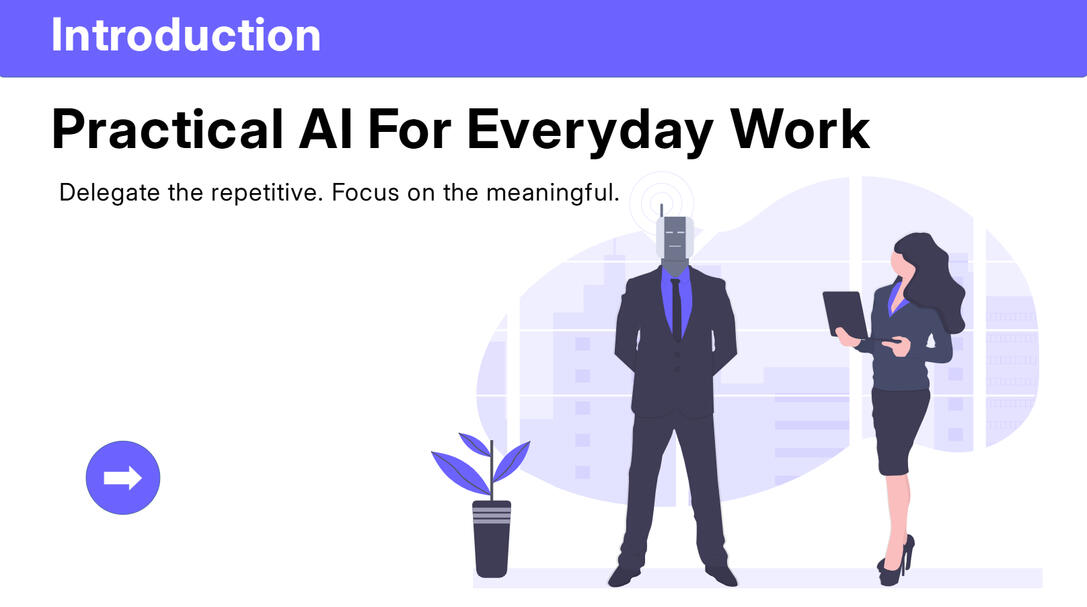
Practical AI for Everyday Work
Helping employees reclaim time by teaching them to work with AI.
Overview
Audience: Corporate Employees
Tools Used: Storyline 360, Figma, Google Workspace
Contribution: Learner Analysis, Instructional Strategy, Storyboarding, Scenario Design, Storyline Development, Visual Design, Prototype Testing
The Challenge
Siddhartha Solutions (a hypothetical consulting company created for this project) noticed a recurring pattern across several departments. Employees were spending a large portion of their day on repetitive tasks such as writing routine emails, summarizing lengthy reports, and organizing spreadsheets. These activities were delaying higher-value work, leaving employees mentally fatigued, and often pushing work dangerously close to deadlines.To address this, the company encouraged the use of ChatGPT. While awareness was high, adoption remained inconsistent. Some employees ignored it completely, others used it incorrectly, and many lacked confidence in the quality of its outputs.
Analysis Approach
If this were a real client engagement, my first step would be to interview managers, observe workplace tasks, survey employees, and review samples of AI-generated work to identify the true performance gap.For this portfolio project, I used that analysis process to define a realistic business problem, learner profile, and performance gap that would guide the instructional design.Based on these assumptions, I designed the course around three core challenges:
• Employees struggled to recognize which tasks were appropriate for AI assistance.
• Prompts were often vague, incomplete, or overly broad, resulting in inconsistent outputs.
• AI-generated work was frequently accepted without evaluation or abandoned instead of being refined.The target learners were employees in non-technical roles such as HR, Operations, Administration, and Customer Support. They had moderate digital literacy, high workloads, and limited time available for formal training.These constraints shaped the learning experience. The course needed to be practical, immediately applicable, and designed to minimize cognitive load while maximizing transfer to the workplace.
Learning Outcomes
By the end of the course, learners will be able to use the IPER Model:• Identify appropriate AI use cases
• Prompt AI using structured frameworks
• Evaluate outputs critically
• Refine outputs strategicallyThese skills will be applied across three common workplace tasks:
• Writing professional emails
• Summarizing reports
• Organizing and cleaning up dataThe learning outcomes were written using Bloom's Taxonomy.
Learning Strategy
Rather than creating a feature tour of ChatGPT, I designed a learning experience set within a realistic workplace environment that mirrors the decisions learners encounter every day.One of the biggest design decisions in this project was beginning with Identify rather than Prompt. Before learners worry about writing better prompts, they first need to recognize whether AI is actually the right tool for the task. Teaching prompt engineering without developing that judgment would only encourage learners to use AI more often, not more strategically.The learning experience follows a consistent instructional sequence inspired by Gagné's Nine Events of Instruction. Each module begins with a realistic workplace situation that requires learners to make an initial decision before any instruction is provided, creating a need to learn rather than simply presenting information. Nova then introduces key concepts through guided coaching, followed by scaffolded practice, immediate consequence-based feedback, and repeated application of the IPER Model across increasingly complex workplace tasks. By revisiting the same decision-making process throughout the course, learners build the judgment and habits needed to write stronger prompts, critically evaluate AI outputs, and iteratively refine them as part of their everyday work.
Storyboard
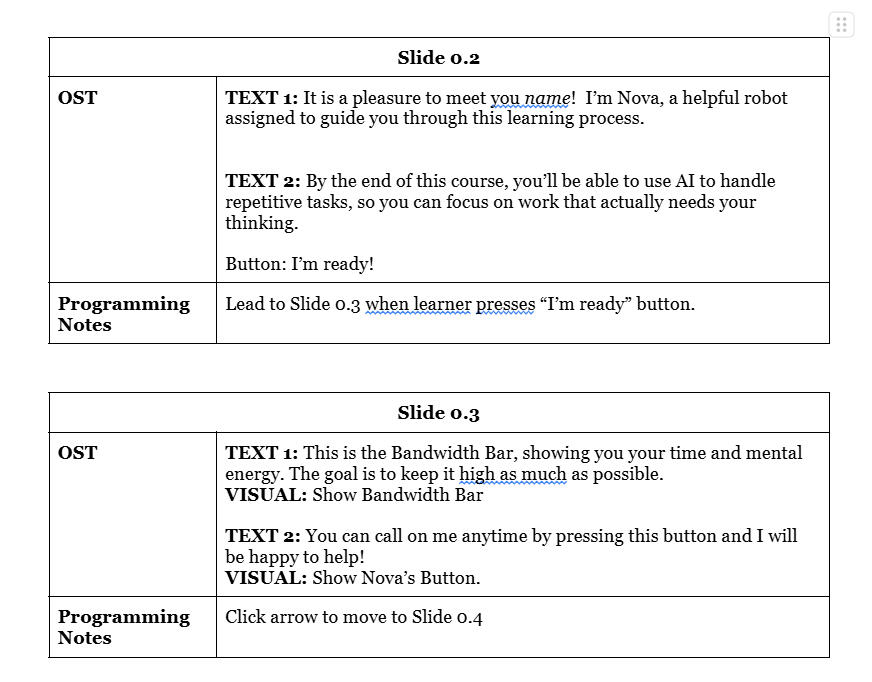
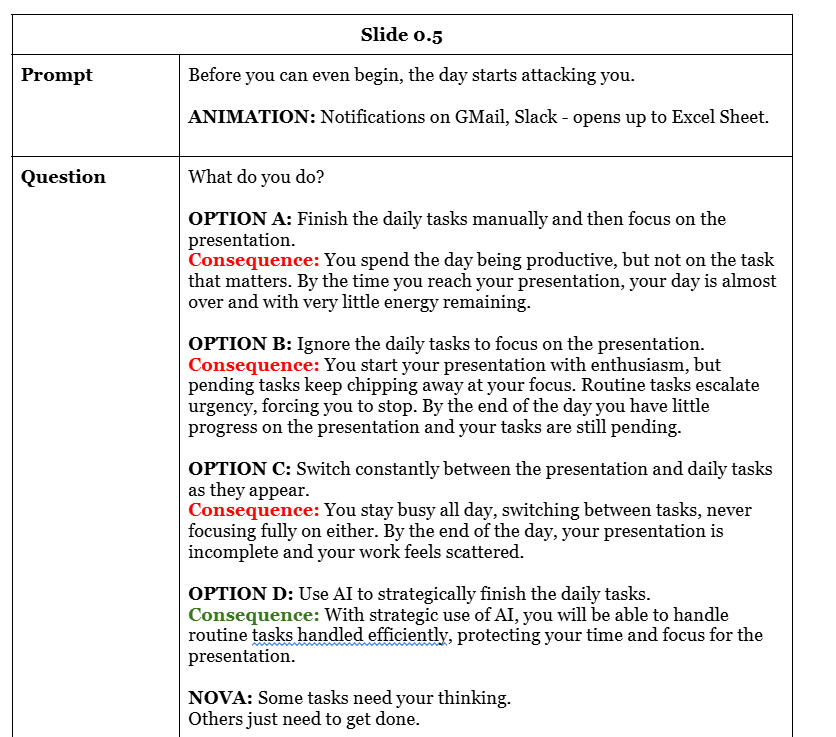
With the instructional strategy established, I storyboarded the complete learner journey—from the opening narrative to the final assessment—before even opening Articulate Storyline 360.
This included mapping every interaction, decision point, consequence screen, Nova coaching prompt, and assessment question to a specific learning objective. Because the course follows a continuous workplace narrative, I also planned how each module would naturally lead into the next while repeatedly reinforcing the IPER Model.Storyboarding first allowed me to test the instructional flow, narrative pacing, feedback strategy, and progression of concepts before moving into development. Several interactions were redesigned during this phase to simplify the learner experience and ensure that every incorrect choice taught a meaningful lesson, rather than simply indicating it was wrong.
Mockups & Visual Design System
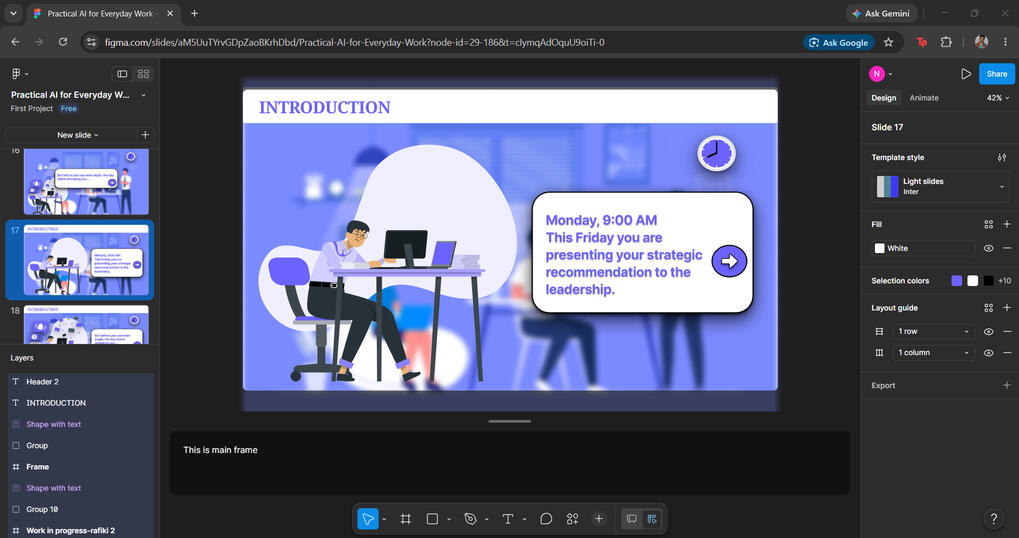
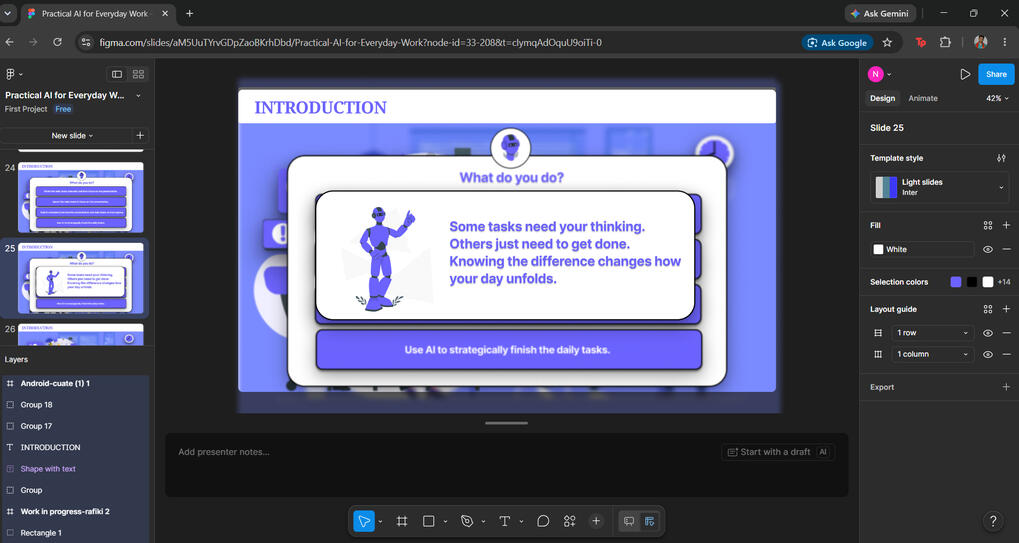
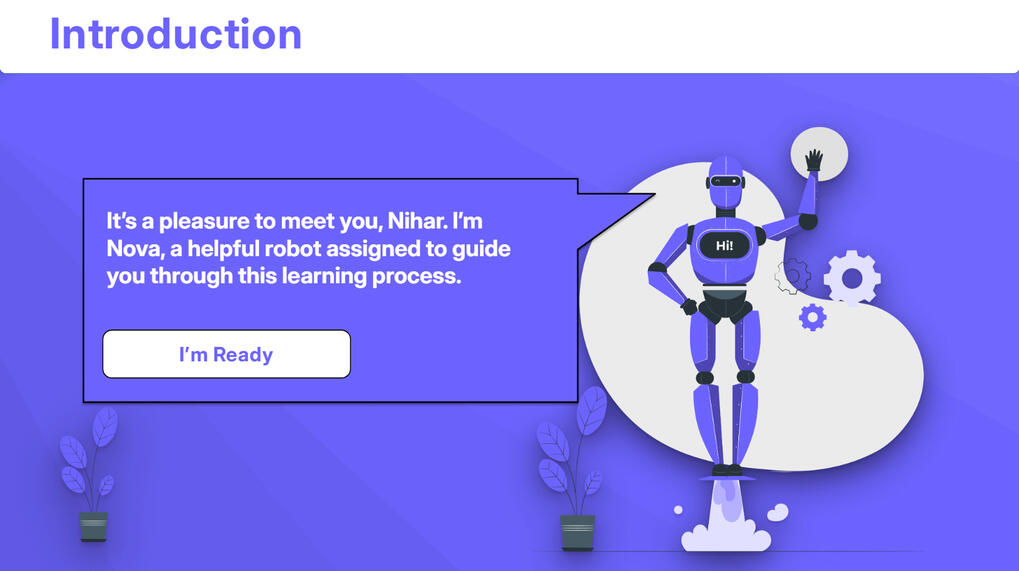
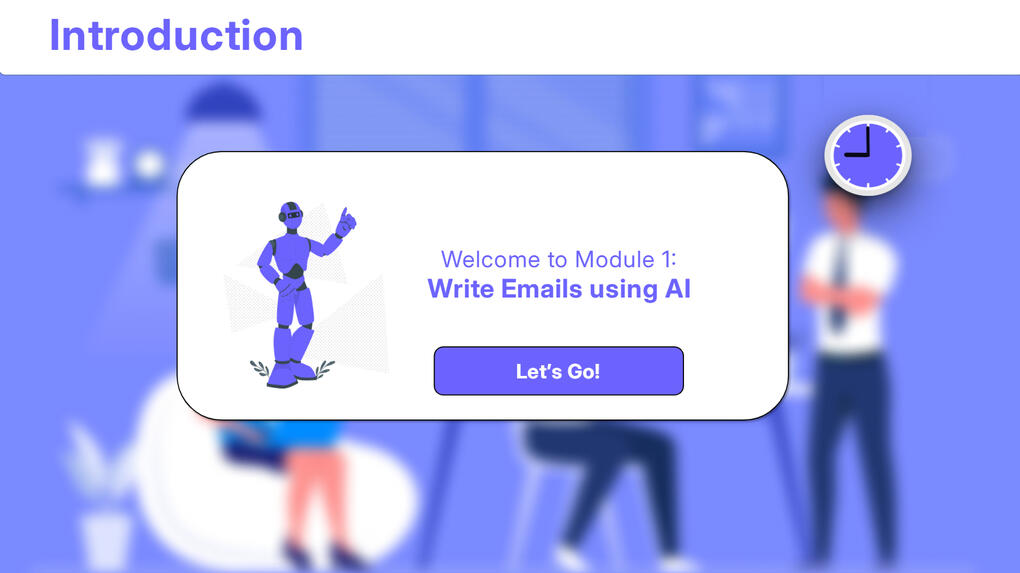
Before developing the course in Articulate Storyline 360, I designed the complete interface in Figma to establish a consistent visual system.The interface uses soft rounded shapes, circular elements, and a vibrant purple (#6C63FF) accent colour to create a clean, modern, and approachable learning experience. I also created reusable layouts and standardized UI components, including backgrounds, characters, dialogue boxes, buttons, navigation, typography, and spacing, to maintain visual consistency throughout the course.Building these mockups first allowed me to focus on instructional interactions during development rather than making visual decisions, resulting in a more efficient workflow.
Development
Because the instructional flow, storyboard, and visual mockups were thoroughly planned beforehand, development in Articulate Storyline 360 was an efficient translation of the design into an interactive experience.The course was built using variables, triggers, layers, states, custom navigation, and interactive assessments, allowing the focus during development to remain on creating a smooth learner experience rather than solving design problems along the way.
Key Decisions

Teach Judgment Before Prompting
Every module starts by helping learners identify suitable AI use cases before writing prompts.

Task-Specific Mnemonics
Simple mnemonic frameworks support prompt construction by not only reducing cognitive load but also encouraging consistent prompt structure.

Evaluation is not optional
One of the biggest mindset shifts in the course is that the first AI output is never treated as the finished product.

Nova as a Pedagogical Agent
Nova provides contextual hints and guided coaching that encourage reflection without giving away the answer, supporting learners throughout the experience.

Learning Through Consequences
Feedback goes beyond "correct" and "incorrect" by connecting every decision to a realistic workplace outcome.

Gamification Through Time
A dynamic workday clock advances after every inefficient decision, reinforcing the value of using AI strategically to save time for higher-value work.
Learner Assesment
The complete course concludes with a 20-question summative assessment that measures learners' ability to transfer their learning to new workplace situations. The assessment presents unfamiliar tasks that require learners to identify appropriate AI use cases, select the correct prompting framework, evaluate AI outputs, and refine them strategically.For this portfolio demonstration, the summative assessment has been intentionally omitted to keep the focus on the instructional design and learning experience. The assessment has been fully designed and storyboarded as part of the project.
Evaluation
In a production environment, I would evaluate its effectiveness using learner feedback, assessment performance, completion rates, and manager observations to determine whether employees were using AI more strategically and spending less time on repetitive tasks.More than assessment scores, success would be measured by observable workplace outcomes such as improved AI adoption, reduced rework, and increased time available for higher-value tasks.
Reflection
Coming from a storytelling background, designing the narrative, characters, and workplace scenarios felt like familiar territory. What I didn't expect was the mindset shift waiting for me.As I designed each interaction, I realized that instructional design isn't just about telling a compelling story. It is about carefully designing the decisions learners make, the feedback they receive, and the subtle cues that influence how they think and behave. I began to appreciate the science of learning in practice: the invisible thread that encourages learners to respond, reflect, and build new habits rather than simply consume information.